The Great Hiring Reset: Why Skills Now Speak Louder Than Degrees
Unlock the power of efficiency in hiring, reducing costs and time-to-hire while securing the best talent for your organization

68% of Indian employers now prioritize practical skills over educational qualifications when hiring for entry and mid-level roles, according to a 2025 NASSCOM survey.
India’s hiring landscape is shifting. The resume no longer holds all the answers; real capability does. Employers today care less about where someone studied and more about what they can contribute from day one.
This is where volume hiring services come in, helping organizations move from degree-based selection to scalable, skills-first hiring models that deliver both speed and quality.
I. Why Skills-First Hiring is Gaining Ground
The Global Talent Crunch Meets Digital Transformation
44% of workers’ core skills will change by 2027, making reskilling a necessity rather than a choice as per the World Economic Forum’s 2024 Future of Jobs Report.
In India, where 65% of the population is under 35, this shift has created an opportunity unlike any other. Organizations are turning to volume hiring models that connect India’s vast talent pool to the rising demand for job-ready professionals who can learn and perform. Four in five tech recruiters believe candidates with certification-backed skills outperform those relying purely on academic credentials (NASSCOM, 2025).
Traditional Hiring vs Skills-First Hiring: A 2025 Comparison
<Content – Table>
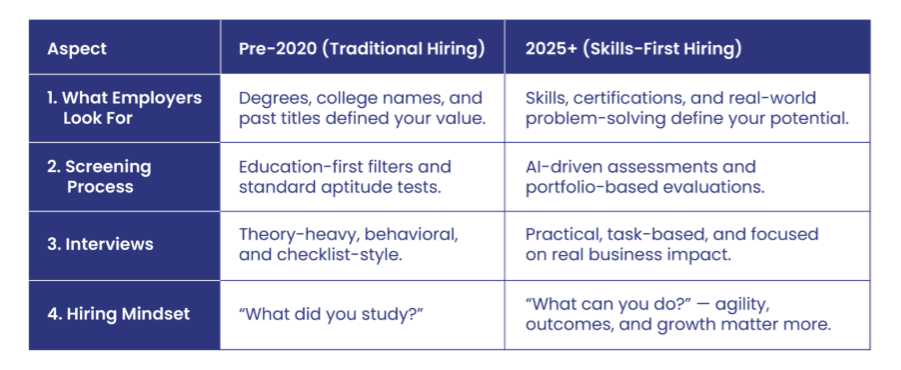
What Employers Look For | Degrees, college names, and past titles defined your value. | Skills, certifications, and real-world problem-solving define your potential. |
Screening Process | Education-first filters and standard aptitude tests. | AI-driven assessments and portfolio-based evaluations. |
Interviews | Theory-heavy, behavioral, and checklist-style. | Practical, task-based, and focused on real business impact. |
Hiring Mindset | “What did you study?” | “What can you do?” Agility, outcomes, and growth matter more. |
II. The Sectoral Impact: Tech, BFSI, and Manufacturing
This shift is no longer limited to technology; every major sector is rethinking how it hires and develops its people.
1. Tech: From IITs to an MNC
Recruiters today assess capability very differently. As hiring evolves, volume hiring solutions focus on skill over pedigree, using simulations, code challenges, and portfolios to find candidates who can truly deliver results. Real-time coding assessments test problem-solving ability, portfolios highlight applied expertise beyond grades, and micro-certifications from AWS, Google, and upGrad validate practical skill.
2. BFSI: Evolving Beyond MBA Filters
In the BFSI sector, hiring is increasingly driven by practical assessments in Excel, SQL, and analytics, AI-led case interviews, and certifications like CFA Level 1, FRM, and upGrad’s FinTech ProTrack. As the industry evolves, organizations are turning to volume hiring providers to scale this skills-first approach with speed and consistency.
3. Manufacturing: Skilled Roles Are Getting a Tech Upgrade
In manufacturing, Industry 4.0 has redefined what “skilled” means. The demand is shifting toward technicians who can operate digital systems and smart machinery. Instead of filtering candidates by diplomas, companies now prioritize those proficient in mechatronics, PLC programming, and IoT protocol.
III. The Infrastructure Behind Skills-First Hiring
The shift to skills-based hiring isn’t just cultural; it’s being powered by smarter systems, redefined processes, and AI-led platforms that make evaluation more accurate and scalable.
1. Job Descriptions, Interviews, and Assessments Are Being Rewritten
AI-led interviews and project-based tasks are becoming standard, supported by bulk hiring services that manage large-scale assessments seamlessly.
2. The Rise of AI-Powered Skill Assessment Platforms

Modern ATS systems are now built to recognize real capability instead of relying on keyword scans. Platforms like Codility and HackerRank support coding roles, Mettl and TestGorilla drive behavioral and technical evaluations, while HireVue and Talview enhance video interviews and soft-skill assessments.
IV. Skilling Platforms as the New Talent Factories

Skills that once took years to learn can now be built in months. As businesses move faster, platforms like upGrad are helping talent keep pace, often in collaboration with bulk hiring firms across India.
Their strength lies in outcome-driven learning with industry-aligned curriculum, placement-focused programs, and live projects that mirror real work environments.
In 2024–25, over 55,000 candidates were placed, many from Tier-II and Tier-III cities, united by one factor: demonstrable skills.
V. What’s Still Broken
Even with progress, the skills-first model faces two persistent challenges. Legacy ATS filters continue to screen out job-ready candidates without degrees, and many platforms still fail to assess soft skills alongside technical ability. Closing these gaps will be key to achieving true merit-based hiring at scale.
VI. What’s Accelerating the Change
Hiring is evolving faster than ever, and the most agile organizations are changing how they discover and develop talent. Two key shifts are driving this momentum: smarter use of technology and stronger partnerships between employers and educators.
1. AI and Bootcamps: The Ultimate Hiring Advantage
AI-led screening paired with bootcamp-trained talent is redefining efficiency and retention. Over 1,500 clients now rely on upGrad Rekrut to pre-vet candidates through simulation labs, hire for real-world projects instead of degrees, and use train-to-hire and trial-to-hire models that turn learning into performance.
2. Employer-Education Partnerships
Top enterprises are partnering with skilling solutions providers like upGrad to co-create training programs aligned with evolving business priorities.
VII. Looking Ahead: The Skills-First Economy
AI-driven assessments, simulation tools, and skills-oriented job frameworks are reshaping how organizations in India hire at scale. Across sectors such as BFSI, technology, and manufacturing, this hiring transformation is anchored in building skills-first talent pipelines through trusted volume hiring agencies and bulk hiring solution partners.
A New Meritocracy Is Emerging
For job seekers, it is about building real skills and proving them through outcomes.
For employers, it is about letting go of outdated tools and rethinking what truly drives performance.
At upGrad Rekrut, every success story reinforces one truth: The future belongs to those who can do, not just those who have studied.
Data Sources
NASSCOM. (2025). India Skills Report.
World Economic Forum. (2024). Future of Jobs Report.
upGrad Enterprise. (2024). The GenAI Gap: Gen Z and the Modern Workplace.
upGrad Enterprise. (2024). The Workforce Wishlist 2025.
upGrad Rekrut. (2025). Placement and Partnership Data.